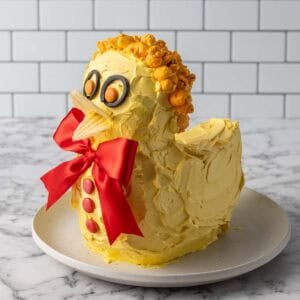
Duck Cake Recipe From Bluey (Step-By-Step Photos)
My duck cake is made with soft vanilla sponge and creamy buttercream. It’s a fun showstopper that’s perfect for Bluey fans and birthday parties.
Ingredients
Soft Vanilla Cake
- 412 g all-purpose flour plain flour
- 3 3/4 tsp baking powder
- 1 tsp salt
- 5 large eggs 55g each, room temperature
- 390 g caster sugar / superfine sugar see notes
- 305 g milk full fat
- 112 g unsalted butter cubed
- 60 g vegetable oil can use canola oil
- 14 g vanilla extract
Vanilla Buttercream Frosting
- 500 g unsalted butter softened (see notes)
- 1 tsp salt
- 14 g vanilla extract
- 20 g heavy cream cold (see notes)
- 400 g powdered sugar
- 5 drops yellow food gel
- 2 drops pink food gel
Decorations
- Licorice strips eyes
- 2 orange smarties eyes
- 3 red smarties buttons
- Red ribbon bow tie
- Cheese flavored popcorn hair
- 2 ruffled plain chips mouth
Instructions
Soft Vanilla Cake
- Preparing your oven - Preheat your oven to 170C / 340F (fan off), 150C / 300F (fan on). Or an even rise, bake with no fan. Position your rack in the middle of the oven. Make sure your oven is fully preheated before making the batter.
- Preparing your cake tins - Spray a loaf tin 25 x 10cm / 10 x 4-inch and a square baking tin 20 x 20cm / 8 x 8-inch with oil spray and line the bottom and sides with baking paper. Set aside.
- Combine dry ingredients - Whisk the flour, baking powder and salt in a medium sized bowl until combined. Set aside.
- Beat the eggs and sugar - Add the eggs to a large mixing bowl (glass or metal) and use an electric mixer to beat until frothy, about 1 minute. A stand mixer with a whisk attachment also works. With the mixer on medium-high speed, add the sugar a spoonful at a time, taking about 1 minute to add it all. Once all the sugar is added, keep beating on medium-high speed for 6 minutes until the mixture is pale, thick, and tripled in size.
- Add dry ingredients to egg mixture - Add half the dry ingredients to the egg mixture and mix on low speed until just combined. Repeat with the rest. The batter will be thick. Avoid overmixing the batter, small lumps are fine, they’ll disappear in the next step.
- Heat milk and butter - Heat the milk and butter in a saucepan over medium heat, stirring continuously, until it reaches 60°C/140°F or small bubbles form around the edges. Do not let it boil.
- Add hot milk - Add half the hot milk mixture, along with the oil and vanilla. Mix on low speed until combined. Add the rest of the milk mixture and mix again until smooth. The batter will be thin and pour in a steady ribbon.
- Divide the batter - Add 600g of batter into the loaf tin and the rest of the batter (about 930g) into the square baking tin. Tap each tin on the counter three times to release air bubbles.
- Bake - Bake both on the middle rack of your oven. The square cake will take about 30 minutes to bake. The loaf cake will take an extra 5-10 minutes to finish baking. You’ll know they’re baked when a toothpick inserted in the center comes out clean. The cakes should be deep golden and spring back when lightly touched. If they sink and don’t spring back, bake for a couple more minutes until ready.
- Cool the cakes - Let them cool in the tins for 10 minutes, then run a knife around the edges to loosen. Transfer to a cooling rack, placing them baking paper side down, and let them cool completely.
Vanilla Buttercream Frosting (make while cake is cooling)
- Cream butter - Add your softened butter, salt and vanilla extract to a large bowl. If using a stand mixer fit it with the paddle attachment. Beat on medium high speed for 5 minutes until pale and fluffy. You will want to scrape down the bowl halfway through with a spatula to ensure everything beats together evenly!
- Add sugar - Scrape the bowl down using a spatula and add all of the sifted powdered sugar. Begin beating on low speed at first. When no dry ingredients are showing, turn the speed up to medium high speed again and beat for 5 minutes.
- Add cream and gel color - finish by adding the heavy cream, pink food gel and yellow food gel Beat in on medium high speed for 2 minutes. Stop the mixer, scrape down the bowl, and beat for an additional 2 minutes.
Loaf Tin - How To Trim the Duck Head & Chest
- Slice the loaf - Take the loaf cake out of the tin and discard the paper. Lay it on its side and slice off one third from one end using a serrated knife. You won’t need the smaller piece. Think of the remaining piece as the head and chest. The head is the top one third of the cake and the chest is the remaining bottom
- Shape the head - To shape the head, cut small V shapes about 2 cm deep around the top third of the cake. These cuts should go all the way around the cake, about one third of the way down from the top. This creates a dip where the neck would be. After that, use your knife to gently round the head shape by trimming the corners and top of the head. This just helps smooth out the head shape. It doesn’t need to be perfectly round.
- Creating the bottom of the chest - The lower part of the cake will become the chest and will sit on the duck’s body. To help it lean back slightly when assembled, trim the base on an angle. Start at the bottom of one end and cut upwards toward where the chest and head meet.
Square Tin - How To Trim The Ducks Body
- Flatten out the top - Use a serrated knife to gently trim and level the top of the cake. You just want to remove any dome so the surface is flat.
- Trim in half and join together - Cut the cake in half straight down the middle so you have two equal rectangles. Place the pieces side by side with the trimmed tops facing out. These pieces will form the left and right sides of the duck’s body. The two long inner sides will be joined together with frosting later.
- Shaping the front and back - Think of a boat shape when viewed from above. The front curves more than the back. Trim one short end of the cake with a deeper angle. This is the front of the duck. Trim the opposite end with a softer angle. This is the back of the duck. These angled cuts help define the overall duck shape.
- Shape the bottom front and back - Trim a wedge from both ends to help the body sit naturally. At the front, cut a short wedge starting about a quarter of the way up the side and angle it down toward the middle of the base. Cut in only a quarter of the way toward the middle. At the back, start about three quarters of the way up and trim a longer wedge, cutting a little deeper than one third of the way in. This creates a gentle curve from front to back.
- Shape the top back of the duck - Move to the back of the cake. Trim a slight curve off the top back edge. This creates a soft, tail-like curve at the back of the duck.
- Cut and angle at the front - At the top front edge of the cake, cut a chunk out on an angle. This will make space for the chest and head piece to sit. Place the chest piece on top to test the fit. It should sit at a slight backward angle. If needed, trim a little more from the body so the chest leans comfortably without wobbling.
Putting it together and decorating!
- Join the body pieces - Use an offset spatula to spread a layer of frosting on the long inner sides of the two cake rectangles. These are the sides that will touch. Gently press them together so they form the full body. This frosting acts as glue to hold them in place.
- Attach the head and chest - Add a bit of frosting to the top of the body where the chest piece will sit. Carefully place the chest and head piece on top. Once it’s in position, insert two long skewers to help keep it steady. Cut the sharp ends off the skewers before using them and push them straight down through the chest into the body. Use scissors or a knife to trim any part of the skewers that stick out. IMPORTANT! Make sure to remove both skewers before slicing and serving the cake!
- Crumb coat the cake - Spread a thin layer of frosting all over the duck to trap crumbs and hold everything together. This is called a crumb coat. It ensures the crumbs are trapped in the first layer of frosting, so they don’t show on the final layer of frosting. Place the cake in the fridge for one hour so the frosting can firm up.
- Frost the cake - Once chilled, cover the duck in a thicker layer of frosting. It does not need to be smooth. A rougher texture gives the duck a soft, feathered look.
- Decorate the duck (right before serving) - Add decorations one to two hours before serving so they hold their shape. For the eyes, cut liquorice strips about six centimeters long and pinch the ends together to make rings. Stick two onto the duck’s head and press an orange Smartie into the center of each. Add three red Smarties down the front for buttons. Press two ruffled chips into the face for the beak. Finish with a red bow tie at the front and a handful of cheese-flavored popcorn on top for hair. The popcorn is just for decoration and should be removed before serving, unless someone wants to eat it.
Video
Notes
Caster sugar - also known as superfine sugar is ideal for this cake as it dissolves into the eggs quickly which will prevent overmixing. Alternatively, you can use granulated sugar or even pulse granulated sugar in a food processor until it’s finer.
Mixing the batter - it’s important to follow the speeds given in the recipe when it comes to mixing. Especially after the flour is added as it prevents overmixing which can cause your cake to be tough. Make sure you scrape down the bowl after each mix to ensure any ingredients that are hiding at the bottom are properly mixed in. It’ll ensure a nice uniform batter that rises in the oven properly.
Mixers You Can Use - Using an electric mixer to make the cake batter is going to make it an easier process and also gives you the best results, especially when whipping the eggs and sugar. You can use a stand mixer with the paddle attachment or a hand held electric mixer.
How to soften your butter for the frosting
Make sure your butter is softened for this recipe. It’ll help with the structural integrity of the frosting. I have a full guide on how to properly soften butter on the blog, but for reference, softened butter is 18C / 65F on a thermometer. Cut it into cubes and let it sit at room temperature for 1-2 hours until it reaches this temperature to until it’s soft enough that when you press on it with your finger, it leaves an indent with some resistance.
Heavy cream - I originally used milk for this recipe, but I’ve made the switch to cold cream instead. I find that milk makes your frosting too soft, and cold cream keeps it’s structure, and using cold cream helps stiffen your frosting while making it smoother. It’s a win win! For this recipe I’d recommend using heavy whipping cream which has about 36% butterfat in it. Check how much fat it has per 100g on the back and that number will give you a percentage.
Storage - This cake can be stored in an airtight container, in the fridge for up to three days. Thaw to room temperature before serving.
Nutrition – is an approximate and is based on per slice. This cake serves 20 little bluey fans.
A note on measurements – This recipe uses weight measurements for the most accurate results. Cup measurements can vary depending on where you are, which affects the precision needed for a recipe like this. Here is where you can learn more about how to measure ingredients using digital kitchen scales.
Nutrition
Calories:484kcal | Carbohydrates:56g | Protein:4g | Fat:27g | Saturated Fat:17g | Polyunsaturated Fat:1g | Monounsaturated Fat:7g | Trans Fat:1g | Cholesterol:115mg | Sodium:339mg | Potassium:73mg | Fiber:1g | Sugar:40g | Vitamin A:869IU | Vitamin C:0.03mg | Calcium:81mg | Iron:1mg
Have you tried this recipe?Tag me on instagram @thescranline!