Home Made Flaky Sweet French Tart Crust (Pâte Sucrée)
This Buttery French Tart Crust, also known as Pâte Sucrée is an all round great recipe for any tart, big or small. Things like French fruit tarts that have no-bake fillings, all the way to baked tarts like my Crème Brûlée Tart. It’s really up to your imagination

Hey guys, Nick here. I’m a fan of a good tart. But it has to start with a really good tart crust. Crisp and buttery. That way you know you’re off to a great start for whatever filling you choose to fill it with. And with a tart, the filling options are endless!
There no bake options like my French fruit tart with pastry cream and fresh fruit, or my chocolate caramel tart which is fudgy and uses my chocolate tart shell recipe. And then there’s my glorious lemon tart which went through way too many tests, but the flavor is so bright.
I’m really excited to show you each step of making this recipe because it went through quite a bit of versions and testing. I’m going to show you how to seal the tart so it doesn’t go soggy with wet fillings, how to fully bake it for no-bake fillings and how to get a nice flat straight edge like the bakeries do.
How to make the buttery dough
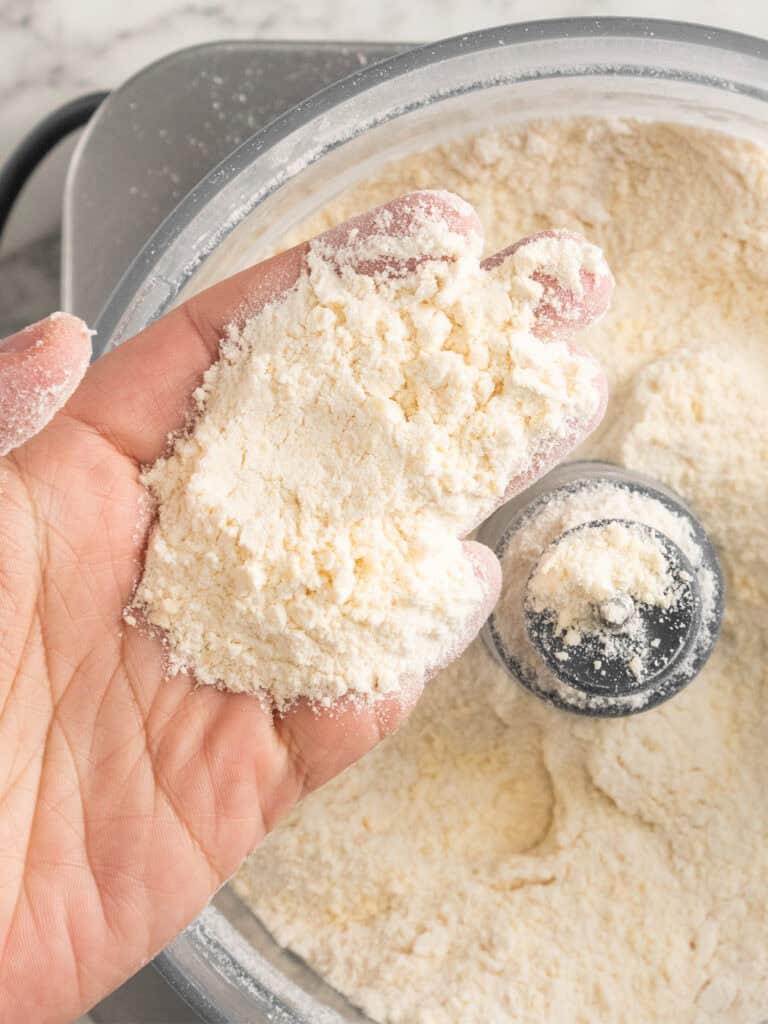
- Add the flour, sugar and salt to the bowl of a food processor. Pulse it until its combined and then add the cold butter until the butter is little lentil sized pieces.
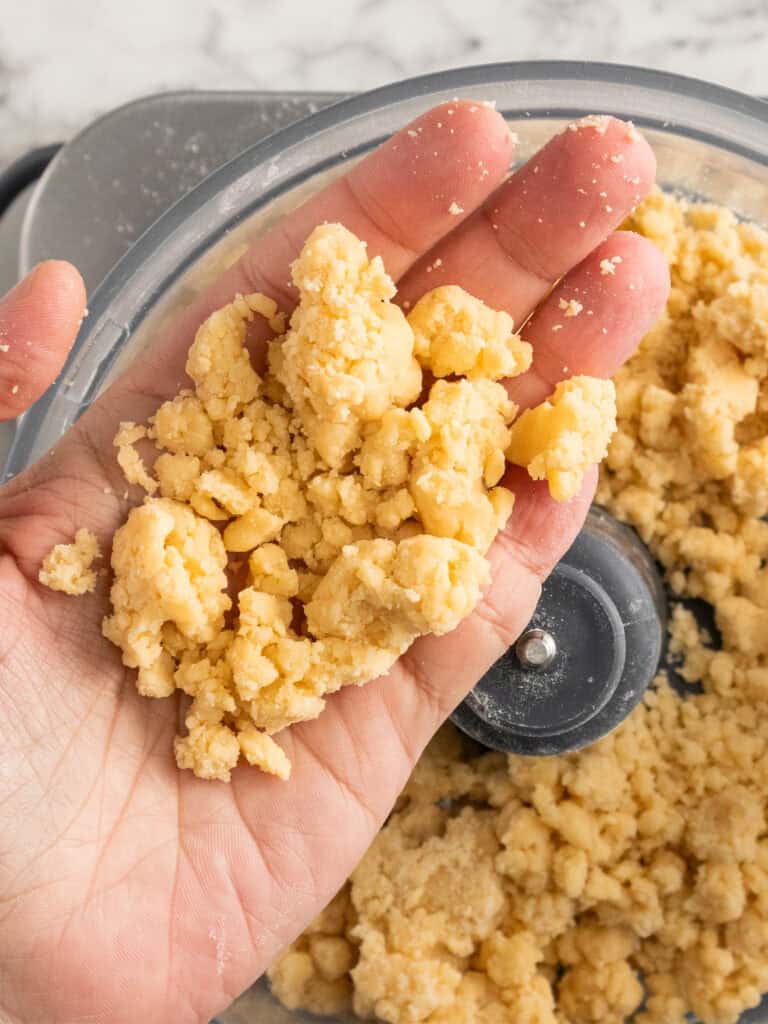
- Whisk the egg yolk, water and vanilla and add to the dry mixture while the mixer is on high speed. Keep it going until the mixture is clumping together. Stop the mixer when that happens.
- If you can squeeze the mixture between your hand and it comes together, then it’s done.
Tip – Take care not to leave any dry ingredients at the bottom of the bowl, and don’t overmix or your tart shell will shrink as it bakes and cools.
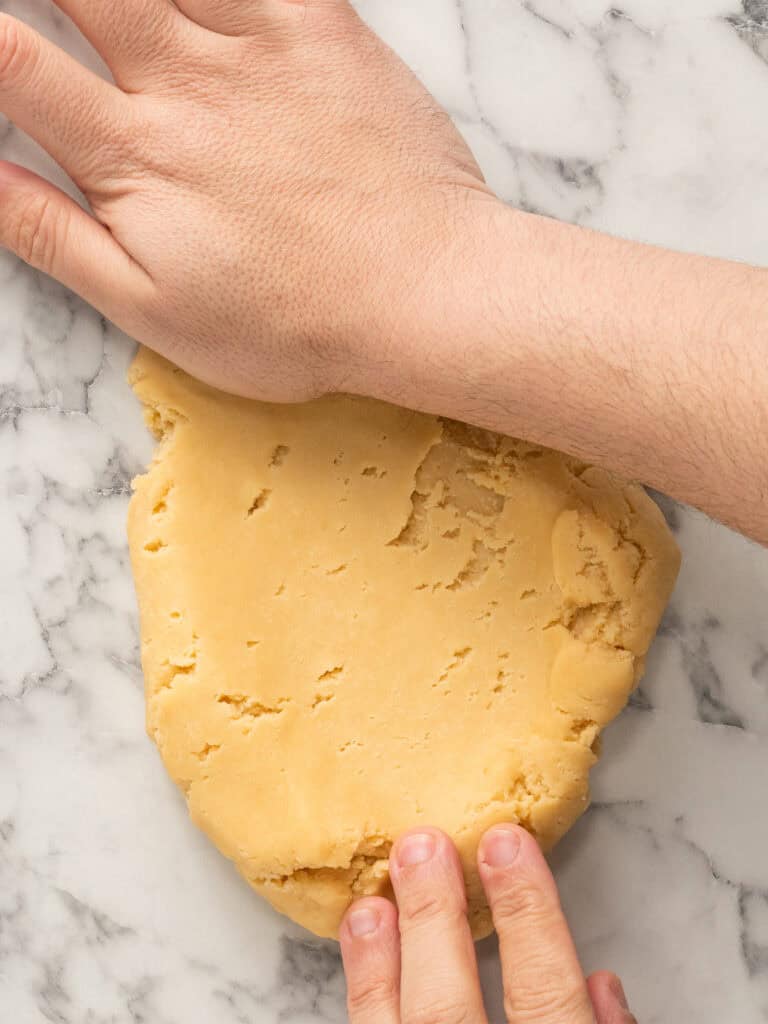
- Fraisage – this is a technique where you use the heel of your hand to smear the mixture against your benchtop a couple times to make sure it’s all evenly combined.
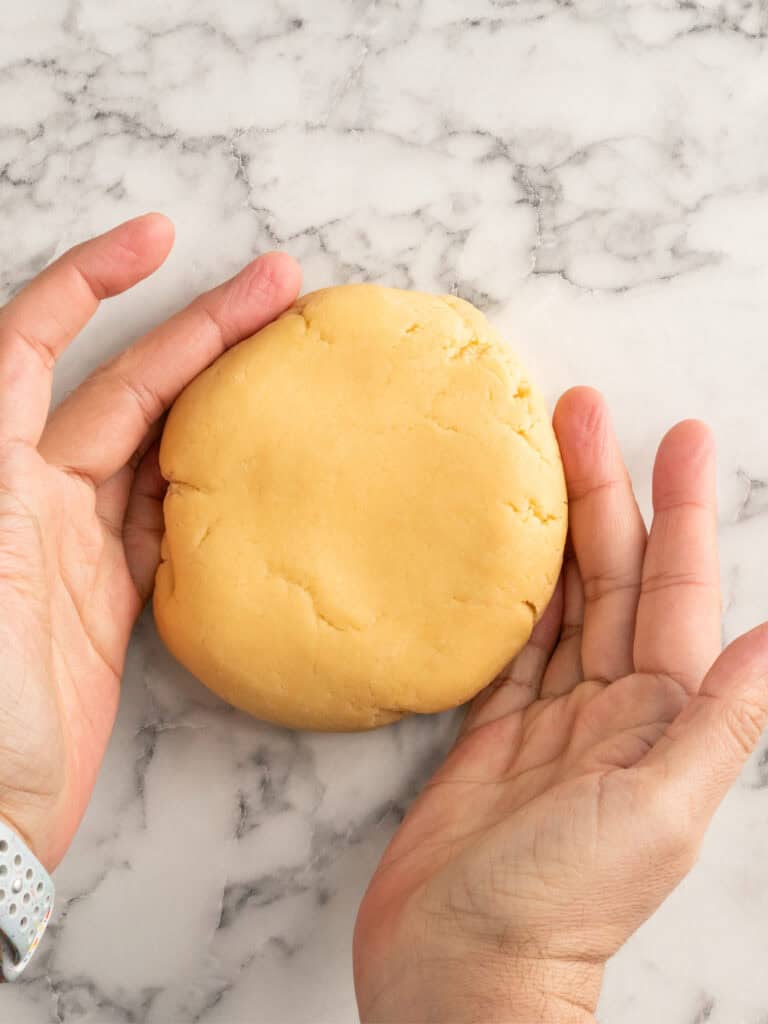
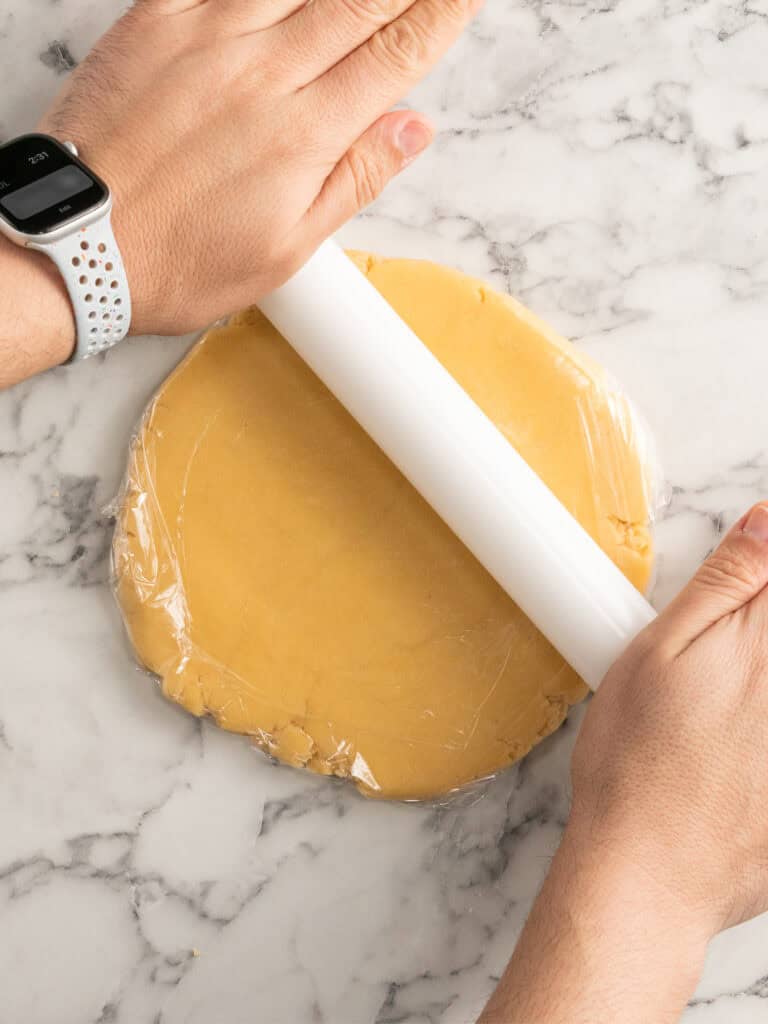
- Form the dough into a ball and then wrap in plastic wrap. Roll out a little flatter with a rolling pin and pop it in the fridge for an hour. That’s going to help hydrate the flour and make the dough easier to work with.
Making the dough by hand – You can absolutely make this dough by hand. Combine the dry ingredients in a large bowl before adding the cold butter. Use your hands to smoosh the butter into the flour between your fingers. When you reach lentil sized pieces of butter, add the whisked egg, water and vanilla and move to using a metal spoon to make cutting motion through the mixture until it forms a dough.
How to roll the dough out
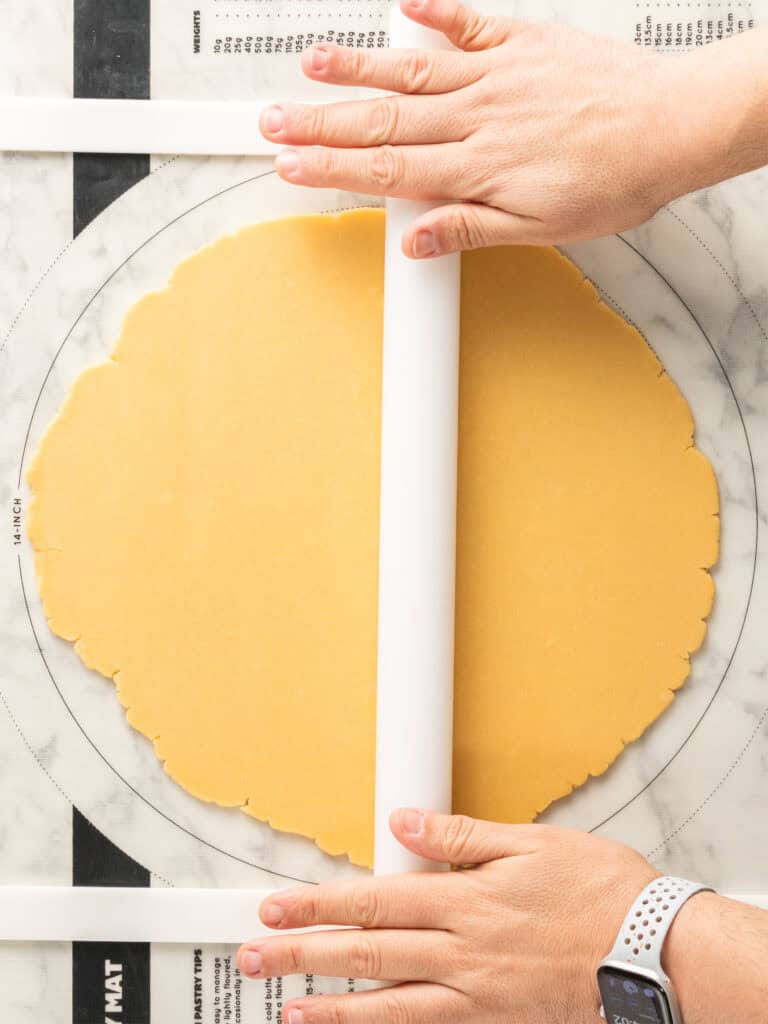
- Unwrap the chilled dough and begin rolling it out on a pastry mat. Instructions below if you don’t have one of those. You may need to lightly dust the rolling pin with flour to stop it sticking to the dough.
- Roll from the middle of the dough outward and turn the dough 90 degrees each time you roll to keep it nice and round. Roll it out until it’s about 32cm in diameter.
If you don’t have a baking mat – I like rolling this dough out on a pastry mat, but if you don’t have one of those you can place the dough on top of a large piece of baking paper and add another piece on top. That’ll stop the dough sticking to the rolling pin. You want to lift the paper up and place it back down every time you roll to stop it creasing.
How to transfer the dough to your tin and form it
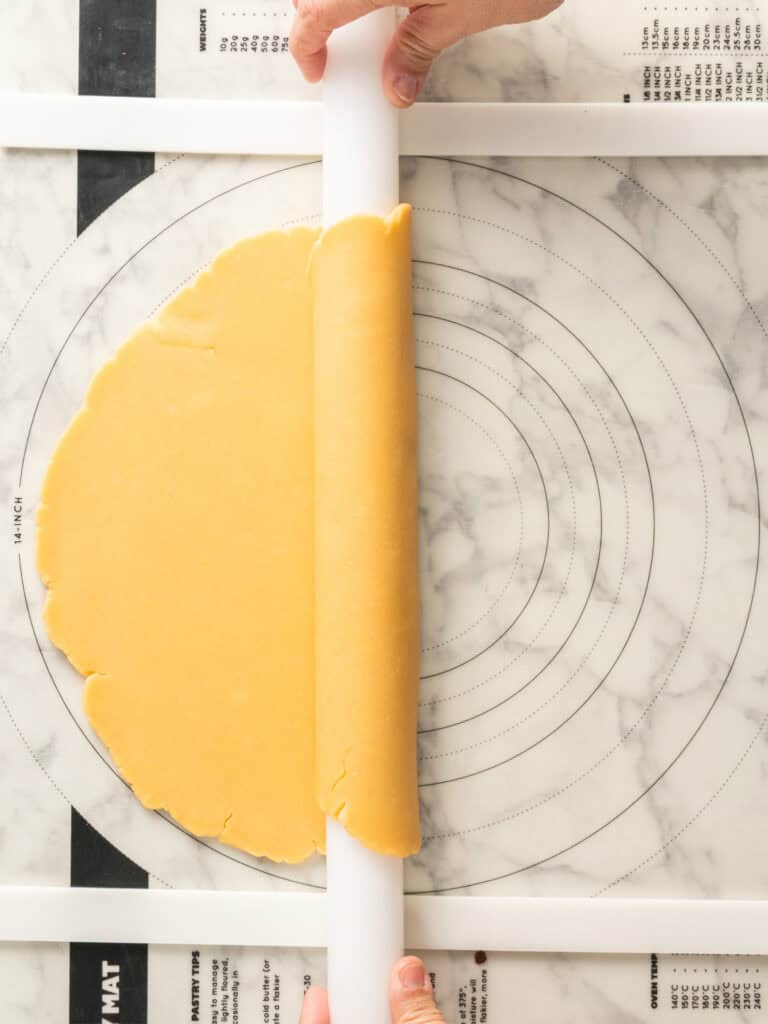
- Roll the dough over your rolling pin, then unroll it over the tart tin. It’s the easiest way to get it there.
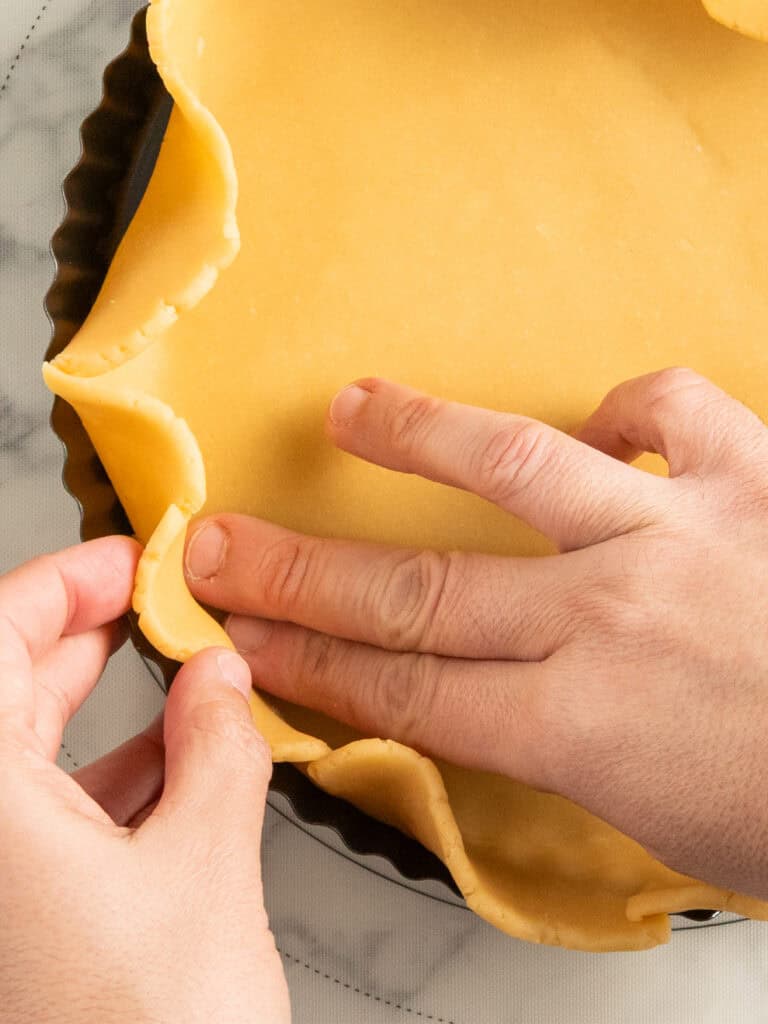
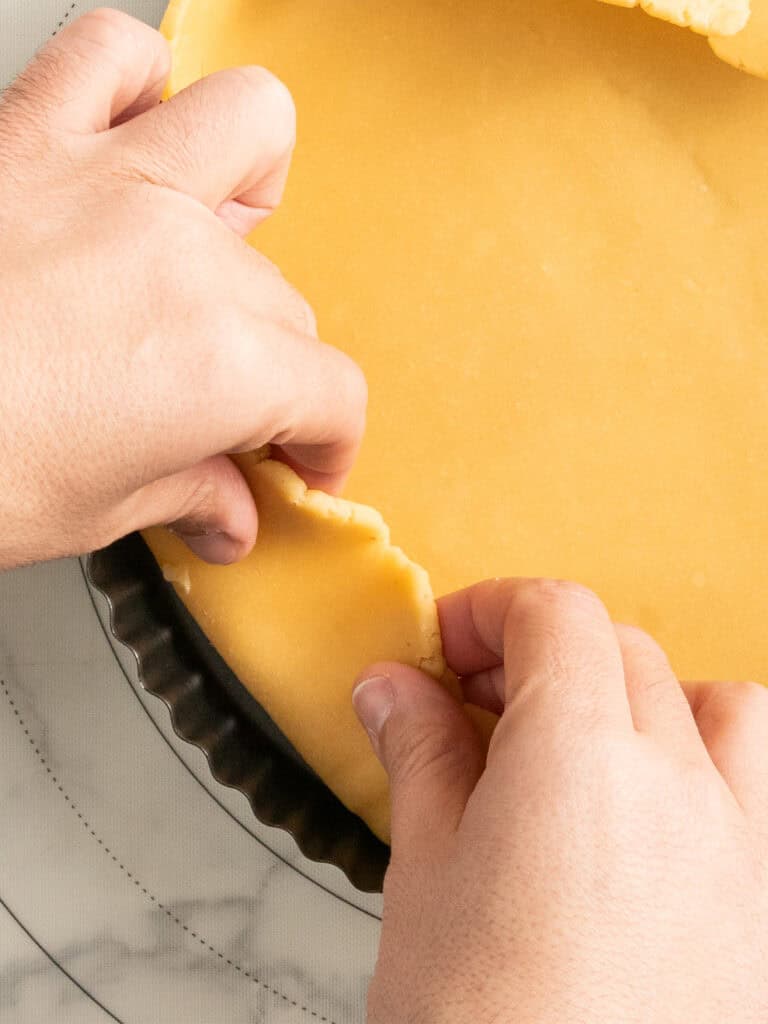
- Let it natural fall into the tart tin. Don’t stretch it! You want to gently encourage it to fall into the bottom of the tin, then fold the sides, but by bit, over one hand and encourage the pastry to go into the bottom corner of the tart.
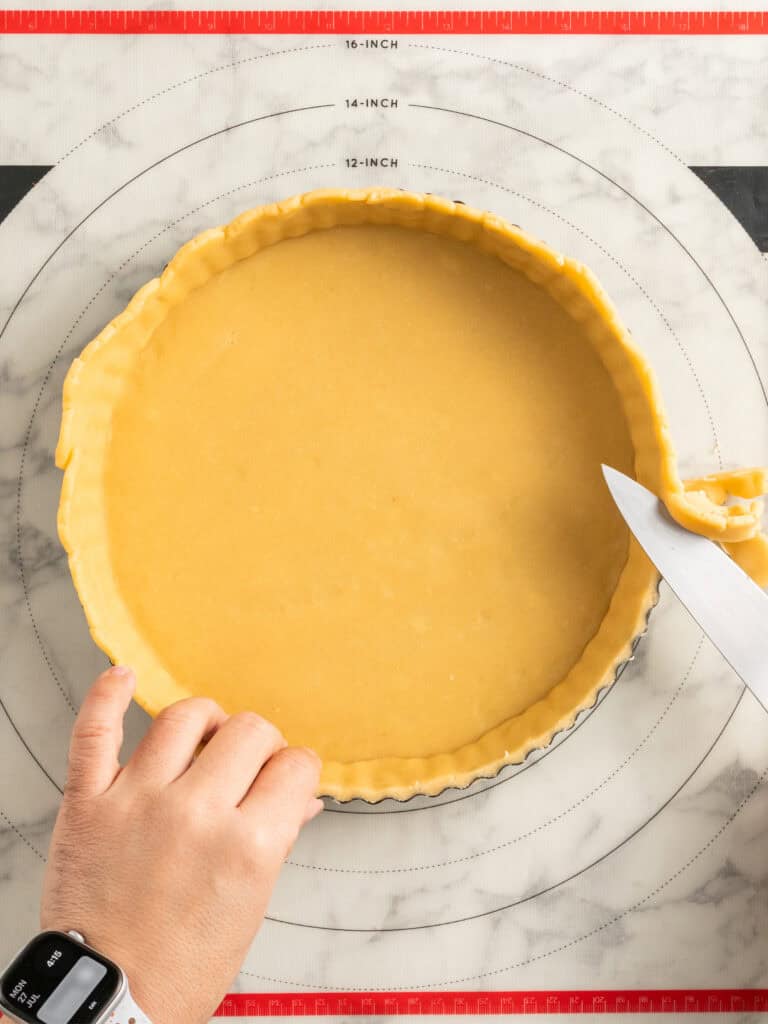
- Then place the dough back on the sides of the tin and press them it with your fingers to help it stay there. Continue doing this as you go around the tin. Pop it back into the fridge and let it chill for 60 minutes.
- Once its chilled, use a sharp knife to trim away any excess dough.
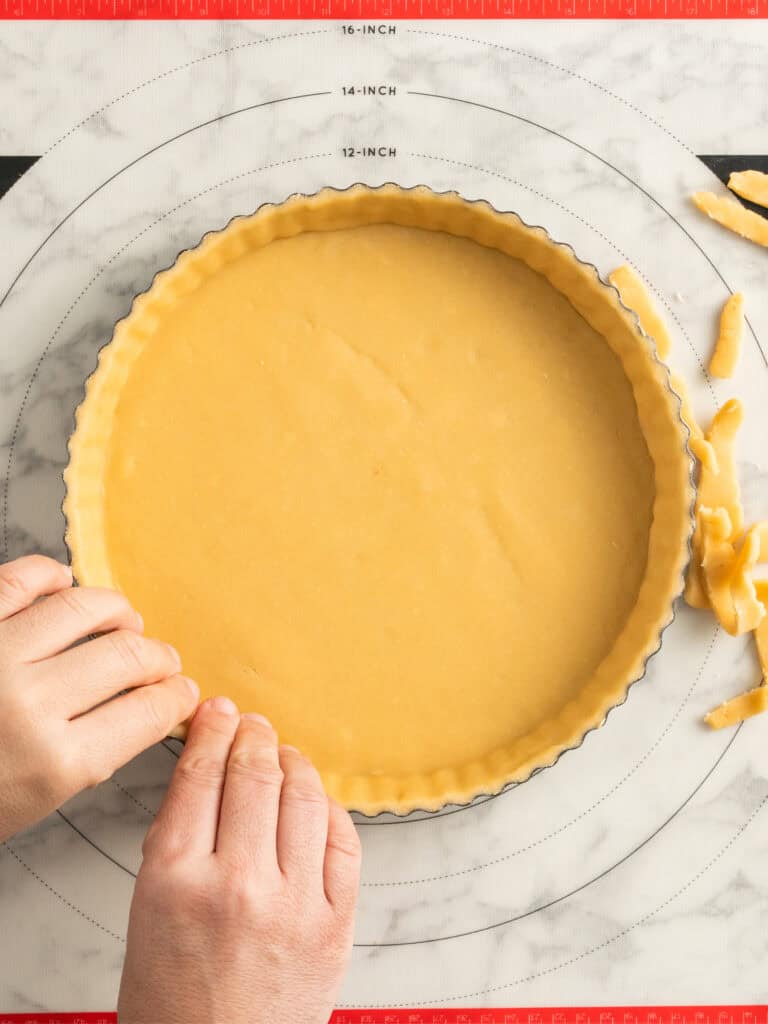
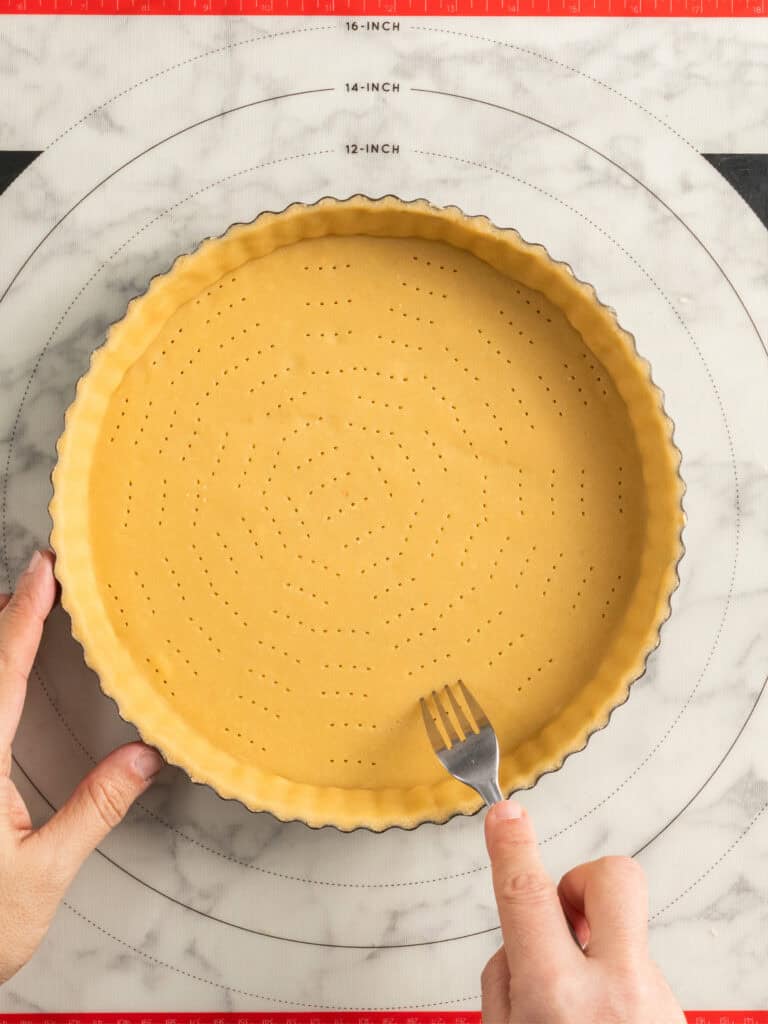
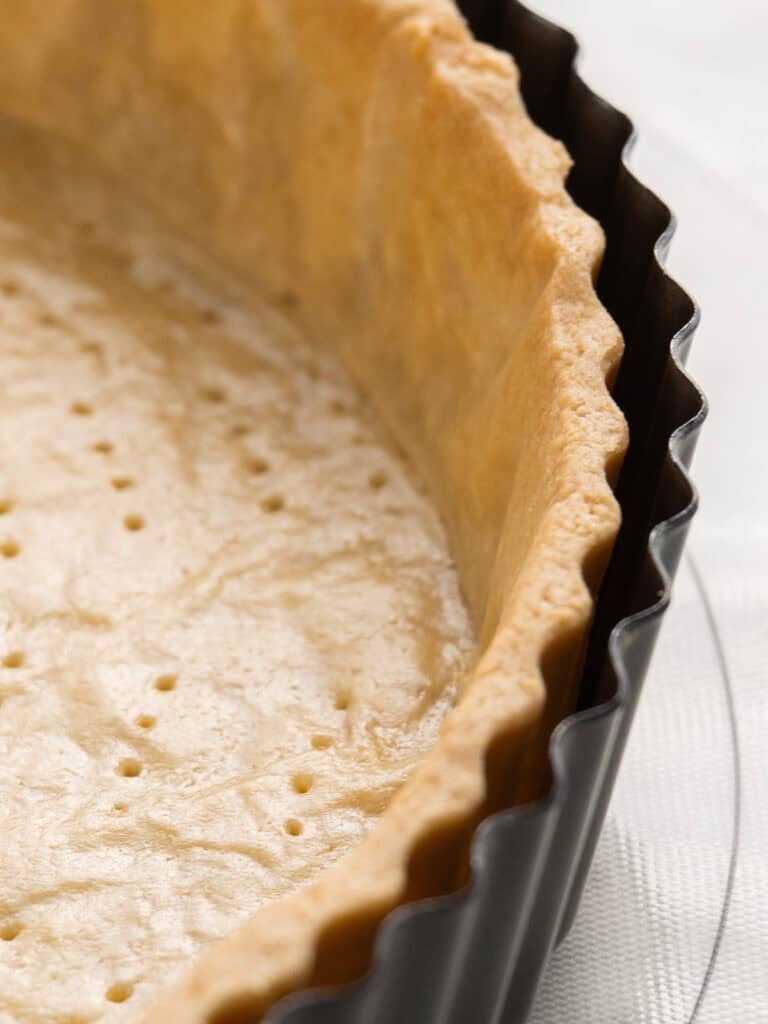
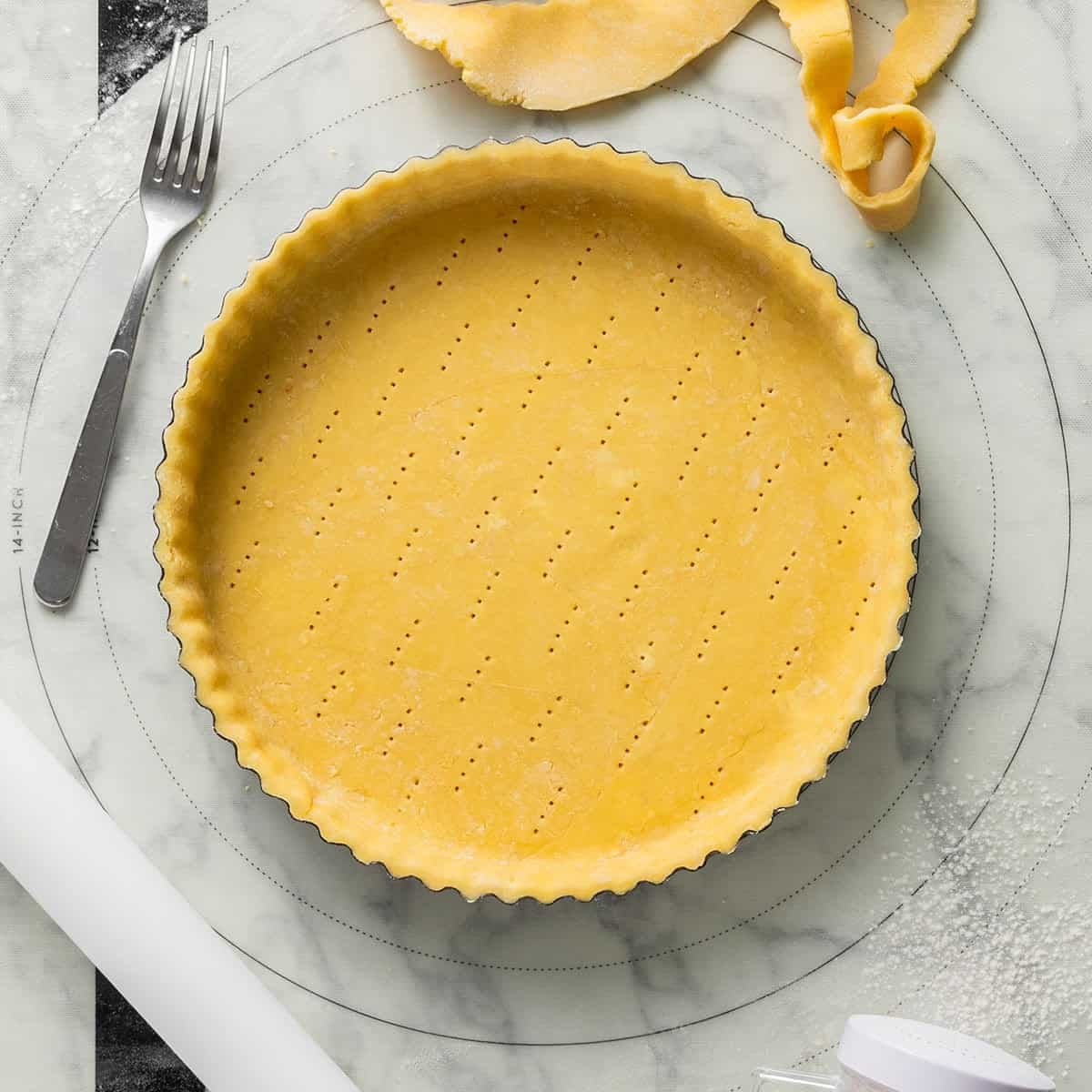
- Use a fork to dock the bottom of the tart tin. This stops it from puffing up later on when you bake it.
Tip – Early on in my testing I stretched the dough a little when forming the tart and when it baked, not only did it shrink with an uneven top, it cracked in the middle! A great big crack for all the fillings to seep through. So make sure you dont stretch your dough!
How to blind bake your tart
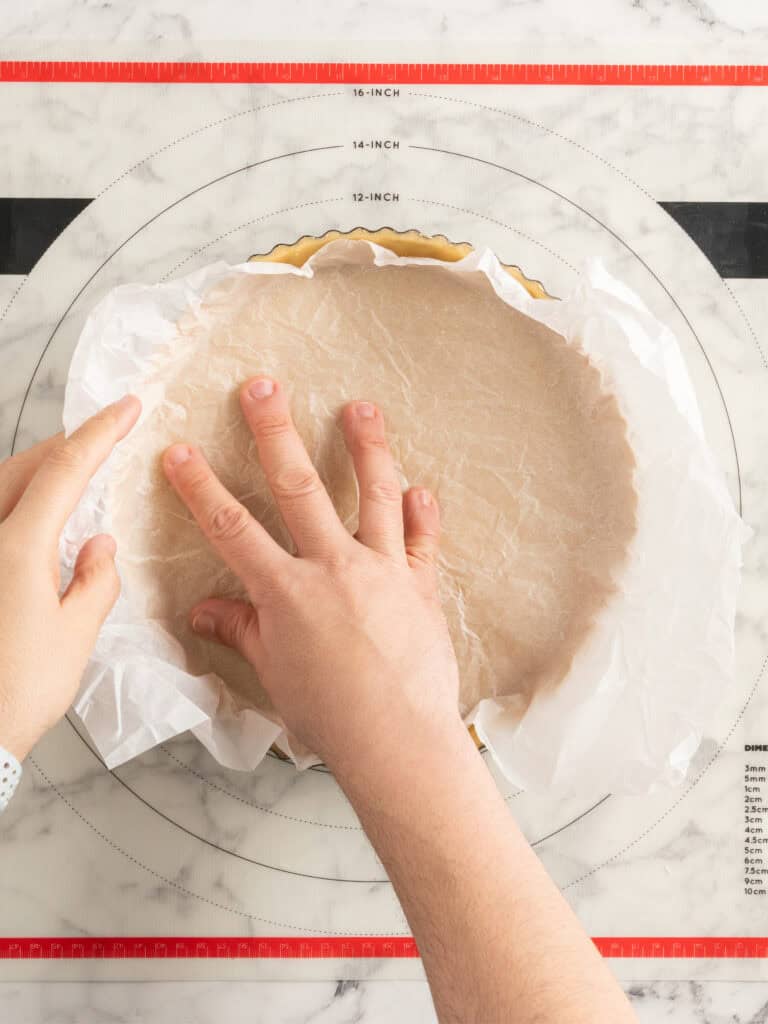
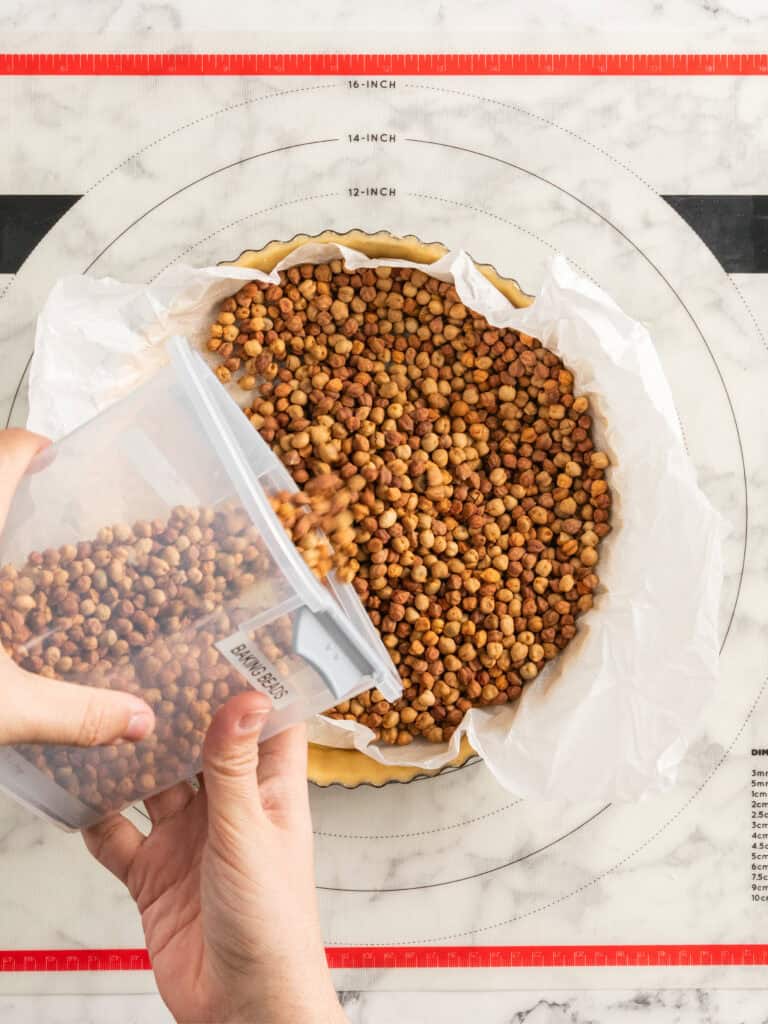
- Scrunch up a large piece of baking paper and place it on top of the tart. Fill with dried chickpeas, if you’re part of the billionaire class, baking beads. Rice will work too. Thid is gonna weight the dough down so it doesn’t puff up. Bake it for 20 minutes.
- This is the first bake. You’re going to bake it for a further 20 minutes or until it’s golden.
Sealing the tart to keep it crisp
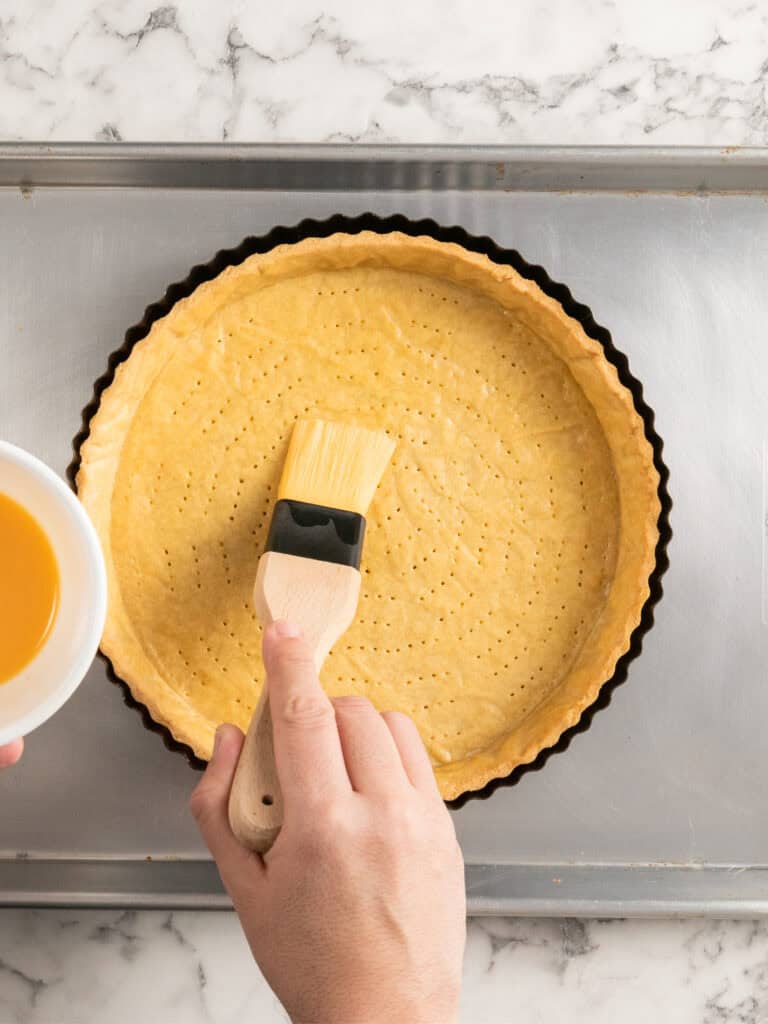
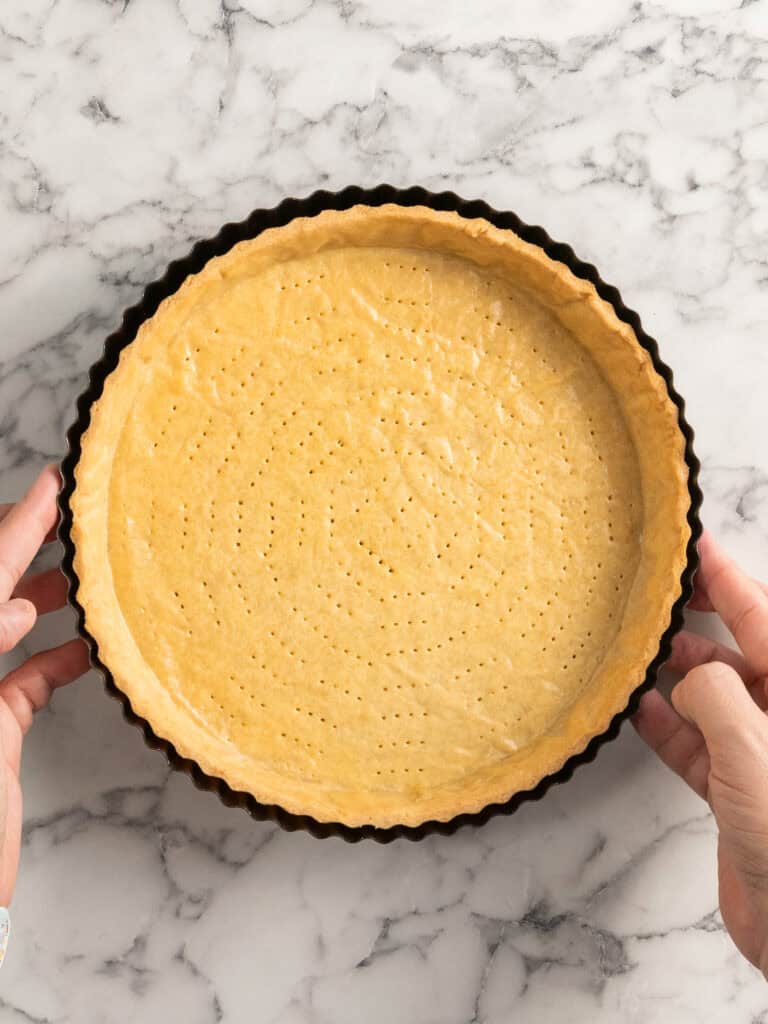
- Whisk together one egg with some cream and then lightly brush the hot tart as soon as it comes out the oven. Bake it for a further 5 minutes.
Your tart is done and its ready for your glorious filling!
A Quick Baking Guide
If you’re new to baking or just want to brush up on the basics, these guides are a great place to start!
Loved the recipe? Let me know!
If you enjoyed this recipe, leave a star rating and comment below. It helps others find the recipe and keeps the baking community growing. Tag me on Instagram so I can see your version too!
Buttery Short Crust Pastry Shell (Pâte Sucrée)
My Buttery Shortcrust Pastry Shell recipe gives you a lightly sweet tart shell that is perfect for baked and unbaked fillings.
Serves 1
Ingredients
Shortcrust Tart Pastry Shell
- 245 g all-purpose flour, plain flour
- 50 g powdered sugar, icing sugar
- 1/4 tsp fine salt
- 100 g unsalted butter, cold and cubed
- 30 g water
- 1 egg yolk
- 7 g vanilla extract
Instructions
Shortcrust Tart Pastry Shell
- Combine dry ingredients – Add the flour, sugar and salt to the bowl of a food processor and pulse to combine.
- Add cold butter – Add the cold butter, hold down the top of the mixer to stop it wobbling and pulse on high speed until the mixture resembles sand, about 2-3 minutes.
- Add eggs and water – Whisk the egg yolk, water and vanilla extract in a bowl and pour into the mixture while the mixer is on high speed. Continue mixing until the mixture begins clumping together to the size of peas. As soon as that happens stop the mixer.
- Fraisage – Pour the mixture onto your benchtop and press together to form a dough ball. Use the heel of your hand to smear small portions of the dough against the bench. You only need to do this a couple times. This helps make sure the dough is evenly mixed and uniform.
- Forming dough and chill (60 minutes) – Form the dough into a ball shape and place on a large piece of plastic wrap. Press down to flatten making sure it’s still a round disc shape. Place in the fridge to chill for 60 minutes. You can make this a day in advance.
- Roll out the dough – I like rolling my dough on a pastry mat but if you don’t have one you can roll it out in between two large pieces of baking paper. To roll it out, use a rolling pin to slowly roll dough from the center outwards rotating the disc 90 degrees every time you roll it. If using baking paper, peel the baking paper away every time you roll and place back on to avoid creases which can cause the dough to crack after it’s chilled. Pinch together any cracks that might form on the outside as you roll it. You want to roll it out to 32cm / 13-inches in diameter and about 3-4mm in thickness.
- Transfer dough over tin – Gently roll the dough over the rolling pin and unroll over a 23cm / 9.5-inch tart tin with removable bottom.
- Forming the tart – Gently lift the dough over the tart tin to allow it to naturally fall into the bottom corners of the tin. Use your fingers to encourage it to get right into the corner bottom of the tart tin. You don’t want to stretch it or it will shrink as it bakes and become uneven. Make sure there are no air pockets, and everything is down neatly. Use a sharp knife to slice away any excess dough or roll the rolling pin over the top to cute away the excess dough and then use your fingers to gently pinch into neater top.
- Chill your tart (60 minutes) – Place the tart in the fridge to chill for a final 60 minutes. If chilling overnight, loosely cover with plastic.
- Preheat a fan forced oven to 165C / 300F (185C / 365F for no fan).
- Dock the tart – Place the tart tin on a baking tray. Use a fork to prick holes into the bottom of the tart shell. This will prevent your tart from puffing as it bakes.
- Blind baking your tart shell – Scrunch up a large piece of baking paper and then un-scrunch and place on the inside of the tart. Fill with baking beads, dried chickpeas or dry rice. Bake for 30 minutes. Take it out of the oven, carefully and slowly lift out the beads using the corners of the baking paper. Place them into a bowl or container to cool down for re-use.
- Second bake – Pop the tart back in the oven to bake for a final 20 minutes or until it’s lightly golden brown.
- Sealing the tart – Brush lightly with egg wash (1 egg whisked with 1/2 tsp cream). Bake for a final 5 minutes. Allow to cool before adding your filling. You can add a filling that needs more baking or let the tart cool completely and add a no-bake filling like a pastry cream.
- How to get a perfectly even top – Use a zester or very sharp grater to gently shave away any bumps or imperfections of the top of the tart shell once it’s completely cooled. Just got slow and don’t press too hard or the tart shell may crack.
Notes
What exact size tart tin did you use?
My tart tin is 24cm / 9.5-inches in width and 3.5cm / 1.25-inches in height. You can roll it out a little wider and thinner for higher tart tins up to 5.5cm / 2-inches in height.
Don’t stretch the dough!
When adding the dough in the tart tin, let it fall to the bottom of the tart tin instead of stretching. If you stretch the dough it will shrink as it bakes and become uneven around the top.
How to easily cut off excess dough using a rolling pin
Use your rolling pin and roll it over the top of your tart. It will perfectly cut it off! You can also do this using a sharp knife.
Baking Beads
You can use dried chickpeas or rice instead of actual ceramic baking beads which can be expensive. Fill them as you would baking beads then once you’re finished with them, let them cool completely in a bowl before placing back in a container or zip lock bag.
Storage – This tart crust can be made ahead of time and stored in an airtight container for up to three days.
Nutrition – Is an approximate and is based the entire tart shell. Obviously, you’re not going to eat the entire thing. Just divide the nutrition information by about 8 which is how many people this tart shell would serve.
A note on measurements – This recipe uses weight measurements for the most accurate results. Cup measurements can vary depending on where you are, which affects the precision needed for a recipe like this. Here is where you can learn more about how to measure ingredients using digital kitchen scales.
Nutrition
Calories : 1881kcal
Carbonhydrates: 238g
Protein: 29g
Fat: 88g
Saturated Fat: 53g
Polyunsaturated Fat: 5g
Monounsaturated Fat : 23g
Trans Fat : 3g
Cholesterol: 409mg
Sodium: 609mg
Potassium : 317mg
Fiber: 7g
Sugar : 51g
Vitamin A: 2759IU
Calcium: 86mg
Iron: 12mg
Nutrition Disclosure
Gave this recipe a go?Mention @thescranline or tag #thescranline!

previous post
3 comments
I already tried this recipe and it works perfectly! Thank you for share! (Greetings from Chile!)
Thanks so much Angel! So glad to hear that! N x
So excited for you guys to try the updated recipe!